
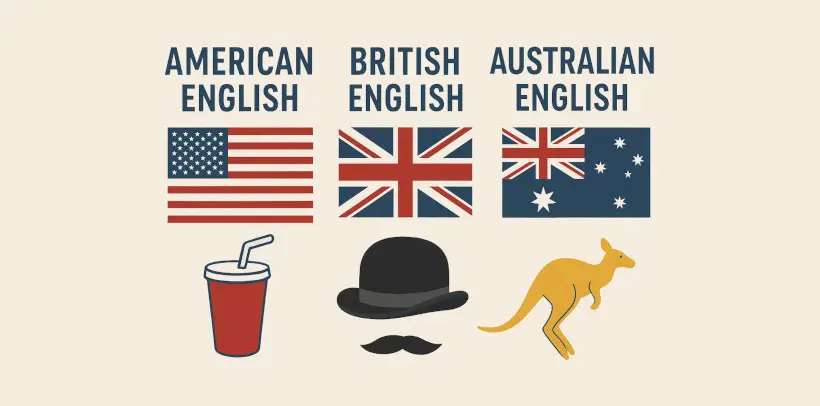
American, British and Australian English: what is the difference?
When studying English, you probably wondered more than once: what kind of English am I learning? American? British? Or maybe Australian? In fact, all these varieties of English are mutually understandable, but they have their own peculiarities in pronunciation, vocabulary, spelling, and even grammar. Let's look at the main differences between them.
1. Pronunciation and accents
American English (US): most common in films, TV series, and music. It has a clear pronunciation of the sounds r and a less pronounced opening of vowels. For example, the word car sounds like [kɑr].
British English (UK): here the r is often not pronounced at the end of the word – car sounds like [kɑː]. There are many accents, including London, Manchester, Cockney and others.
Australian English (AUS): the accent is a bit like the British accent, but with a softer intonation and a characteristic rounding of the vowels. For example, the word mate often sounds like [maɪt].
2. Vocabulary
Each version of English has its own unique words:
|
|
USA |
UK |
Australia |
|
Elevator |
elevator |
lift |
lift |
|
Shop |
store |
shop |
shop |
|
Vacation |
vacation |
holiday |
holiday |
|
Trash |
trash can |
bin |
rubbish bin |
|
Short vacation |
getaway |
break |
bush holiday |
|
Kangaroo |
kangaroo |
kangaroo |
roo |
Australians also actively shorten words: afternoon → arvo, breakfast → brekkie, barbecue → barbie.
3. Spelling
Some words are spelled differently depending on the region:
color (US) vs colour (UK/AU)
center (US) vs centre (UK/AU)
organize (US) vs organise (UK/AU)
4. Grammatical nuances
Present perfect: the British use this form more often:
UK: I have just eaten.
US: I just ate.
Collective nouns:
UK: The team are playing well.
US: The team is playing well.
Australian English mostly follows British grammar, but allows American variants - especially in informal speech.
5. Culture and context
It should also be taken into account that language is a reflection of culture. In the US, business terminology is more common, in the UK - classical literary expressions, in Australia - casualness and humor in the language. Therefore, learning a specific variant may be related to your goals: travel, study, work or immigration.
What to choose?
All three variants of English are correct. The main thing is to be consistent: if you are learning British English, it is better not to mix it with American. In my courses, I help students not only learn the language, but also understand the cultural characteristics of the English-speaking world.
Do you want to speak English fluently, regardless of your accent?
Enroll in courses & we'll choose the option that's right for you!
